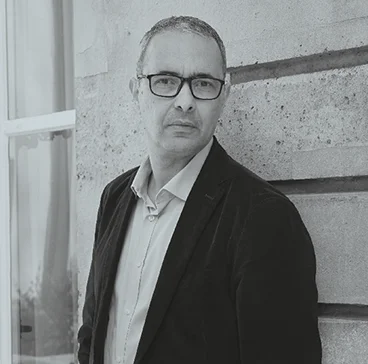
Kamel Daoud
Algeria/France
Imagine if you were legally forbidden from speaking publicly about the defining era of your life. This is exactly the situation Algerians facing regarding the civil war of the 1990s – the ban on speaking out is intended to serve national reconciliation.
Kamel Daoud’s latest novel, Huris, defies this ban and unfolds a dense, unsettling narrative of violence, memory and female self-assertion, giving literary form to the unspeakable. At its heart is Aube, a young woman whose body and life story are shaped by the traumas set in the 1990s. Daoud writes in a vivid, often fragmented style that intertwines narrative concision, essayistic reflection and political analysis. Huris was awarded France’s highest literary honour, the Prix Goncourt.
Daoud, born in Mostaganem in 1970, studied literature and worked for many years as a journalist, primarily for the Quotidien d’Oran, where he made a name for himself with his sharp-tongued columns. He gained international recognition with his novel Der Fall Meursault – eine Gegendarstellung, which was read as a postcolonial response to Camus’ The Stranger. Since the Algerian government banned Huris and issued an international arrest warrant against him, Daoud has lived entirely in France.
Huris. Novel. Translated from French by Holger Fock and Sabine Müller. Matthes & Seitz 2025
Meine Nacht im Picasso-Museum: über Erotik und Tabus in der Kunst, in der Religion und in der Wirklichkeit. Kiepenheuer & Witsch 2020
Der Fall Meursault – eine Gegendarstellung. Novel. Translated from French by Claus Josten. Kiepenheuer & Witsch 2016
Back...